Tuesday, 28 June 2016

Notes from 28th June 2016 Session:

  • If it sounds to hard, DON'T!
  • Think about the ROLE you are taking and what your AUDIENCE would want to see.
  • Real life contexts.
  • Audience, audience, audience
  • Writing for enjoyment is fine (7 minutes write) as it is for fun, can incorporate learning intentions from workshops, purpose can be to share with a partner and to publish one every second week. (2 minute challenge)
  • Look at the next steps. Planning & ideas.
  • Focus on content first, surface features second
  • Spelling needs - kids wont try big words if cant spell, so could limit ideas recorded (might generate complex vocab, but spelling stops them using it).
  • Spelling needs to happen and be incorporated in independent work.
Needs:
Student needs to plan - WALT:
= draw a picture plan with labels, with phrases 
= use graphic organiser to sort sequence info [use a variety of graphic organisers] 

Student needs to develop ideas... or relevant content - WALT:
=generate ideas
=develop ideas

Student needs to develop 'revision/editing skills... - WALT:
= recraft

If your students need to proof-read... self correct with independence  - WALT:
What scaffolds will you be putting in place before they write more than 6 sentences

Adding detail - lessons and places to go are endless but the needs of the kids are all around this.

  • Complex sentences - Re-read Jeff Anderson - Mechanically minded.    - sentence interruptions - openers and closers
  • Word choice - precise nouns, activated nouns etc...
  • Punctuation for effect

Audience Audience Audience

Context: Winter  (weekends, noticing walks, images, movies)
Audience: A school in Samoa (picking an audience who will require the detail you want the kids to include)
Format: Explain, Entertain
Model: Teacher creates a model. Analyse it to find success criteria. 2 models - a model to see - modelling the writing process
Success criteria: comes from the model and students needs 

Split screen works well.
We are adding detail ..... by including a second idea to a sentence

Acceleration:
Pre load vocabulary for next weeks journal article so they bring the knowledge and can focus on ideas instead of decoding and clarifying difficult vocab.


    Tuesday, 24 May 2016

    Readings: Insights into learning.

    _________________________________________________________________________
    #1


    I appreciated this link from a reading Ann gave us recently which connected perfectly with the idea of 'Split Screening', which we heard at a recent Kath Murdoch Inquiry course I attended.

    "Split Screening' is a concept created by Guy Claxton. The idea of split screening is to not ignore the 'what are we doing' of the task, but to use it along side the 'what are we learning to do' in the task.

    __________________________________________________________________________

    #2

    I think a key for me in my inquiry is the last question. I am reasonably confident that my students could answer the first three questions, the fourth I am not so confident about.

    What will I do about this? Through making the learning clear (split screening), and by adding accountability to the kids to put learning in workshops into practice in their independent writing. If the students can show where they have used a skill they have learned, then they and I will know the have been successful.


    Monday, 9 May 2016

    What do I need to do as a teacher to get the kids to care about writing? Editing?

    My inquiry question is - What do I need to do as a teacher to get the kids to care about writing? Editing?

    My end point would be for the students to:
    • Willingly recraft
    • Independently check success criteria
    • An enjoyment of playing with words
    • Plan for writing

    My next steps:
    • Attempt to develop some care (quick writes)
      • responses to video clips
      • noticing walks
      • Diary / Journal of interests (happy, sad, angry, afraid...)
    • Playing with words experiences (short sharp)
      • synonyms
      • challenges - use words three different types of sentences
      • images, movies, sounds
    Gather some Baseline Data:
    • student voice - question them and parents
    • e-asttle data about a goal/rubric score
    • pick 6ish kids as a target group
    Personal Reading:
    • Gail Loane
    • Spandell


    As a side note:

    Independent Writing:
    • simplify tasks 
    • success criteria for a purpose (generic for the type)(shared development of models)
    • teacher to not focus on the piece, focus on the skills/goals ignore the rest
    • Genre in the third week
    • Plan 3 types relating to eg personal expressive

    Thursday, 7 April 2016

    'Who could it be now'


    As the Police sung it!  I see my focus students as the following children who all have ideas and are willing writers, but very unmotivated or just unsure about applying learning to independent writing and being able to edit or be self aware of the need to edit.

    Wade
    Christopher
    Jamie
    Kaleb 
    Ryan 
    Alexus
    Sam D


    Why them?

    All of these students are willing writers and capable of participating and contributing to writing in groups and independently, but when it comes to applying skills and learning independent of the teacher they don't.

    What could the inquiry be about?
    • Boys motivation, sporty kids motivation
    • understanding where to next
    • ownership of where to next
    • planning vs not
    • sharing unpacking
    • honesty about levels (home truths)
    • exemplars
    • skills sessions vs genre teaching


    Wednesday, 6 April 2016

    What is going on for my Learners? How do I know?

    Some attitudes or behaviours that I have seen. 


    • Mostly Interested and excited about sharing their ideas though writing and oral mediums.
    • Half often have ideas to write about, other half often don't.
    • They all enjoy have models and prompts to write about and follow.
    • Some admit to being unsure of how to start, a lot are in the same boat but wont admit it.
    • Most feel they are finished after their first draft. I'm done I don't need to edit. Experience tells me that they don't know how to edit!
    • Little care for BEST. They don't see their mistakes. They read in correct structures and punctuation but don't fix it up.
    • Most wont freely admit to being confused in front of their peers. Those that are willing to say that they are confused, are the more capable writers. They take charge of their learning more than the others.
    • Boys minds work faster than they can type or write, so their ideas flow out in their heads but they can't keep up so ideas get missed, lost or jumbled.
    • No matter how kid speak I try and make success criteria and learning intentions, I still manage to confuse the kids.
    • They can recite success criteria and LO's but don't know what success looks like.
    • Me. "What is your LI?" Child explains it perfectly. Me. "so why have you not shown it or thought about it in your independent writing?" Child shrugs shoulders. "I don't know. I just didn't think about it when I was typing." Me. "Why didn't you add detail after you had finished?" Child. "I had finished."
    • Lack of engagement with LO's and success criteria unless teacher driven.
    • No interest in planning.
    Next step. Interviews/Questionnaires.

    Wednesday, 30 March 2016

    Scanning

    Over the past month we have begun assessing our students writing using the e-asttle tool. Below are some of the trends and common next steps for the writers I teach.


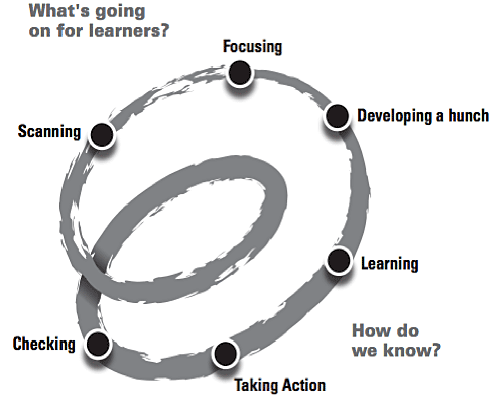
    Spiral of Inquiry

    In 2016 at David Street School, we have embarked on a journey of discovery about our students, our pedagogy and how we teach in relation to the core curriculum area of Writing. The inquiry tool we will be using is the Spiral of Inquiry which looks like this.


    The idea is that we investigate into our students learning in writing and look for their beliefs, behaviours and outcomes while learning how to write. From this we develop hunches about key points of actionable changes to the way they learn and we teach. The onus is then on ourselves as teachers to improve and adapt to hopefully make a difference to their learning to accelerate growth.

    The thing I like most about any inquiry model is that taking a risk is good and mistakes are acceptable. The important thing is that the students needs are at the heart of this inquiry cycle.